Turn any subject into a sandbox game students can't stop playing
No levels, no right order, no "wrong answer" screen. Students build whatever they like and the world reacts the way the real one does. Free play still teaches, because you design what's in the box and the rules inside it. Here's how to build one with Claude.
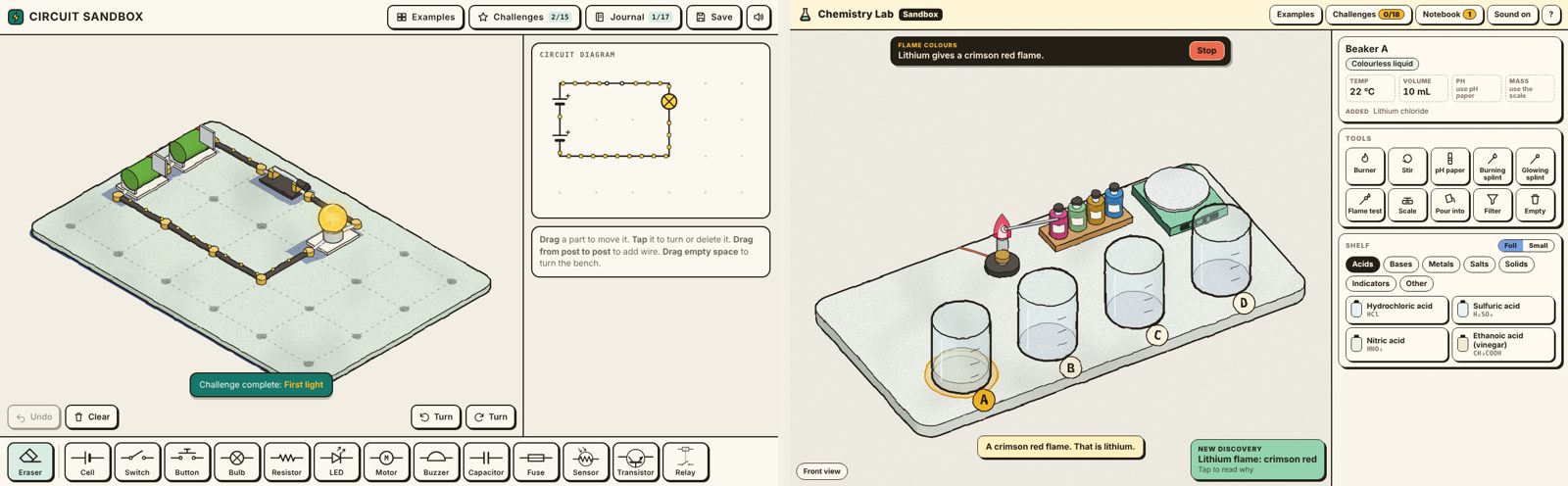
What free play does that a lesson can't
"What happens if I add this?" Students ask their own questions, then answer them by trying. Nobody has to tell them to keep going.
Too much current burns the fuse. The wrong acid makes no gas. In a sandbox, failing is just another result to find out about.
One sandbox works as a demo, a lab, homework or a challenge race. The same bench covers chapter after chapter.
Free to play, but built in 4 layers
A sandbox teaches because of what you put inside it, not because it gives orders. Plan these four layers and the learning happens on its own.
The parts
The "things" of your subject that students pick up and place.
Batteries, bulbs, switches. Acids, metals, beakers, burners.The real rules
How the parts behave together. This is where your lesson lives.
Current flows only in a closed loop. A metal pushes hydrogen out of an acid.Things to see
Readouts, colors and sounds that make the rule visible.
Meters, temperature, pH, a flame color, a squeaky pop.Light goals
Optional nudges on top of free play. Students can ignore them.
Examples to watch, challenges to try, a notebook of discoveries.Read the full guide free
Sign in with Google to unlock every step, prompt and example. Free, no card.
- Sandbox ideas for every subject
- Build your sandbox
- One sandbox, many lessons
- Sandboxes built this way
- Get new DIY guides by email